

Role
Senior Product Designer (2025 to now)
Teams involved
Product・ML・Frontend・Backend・Data Engineering・Clinical・Marketing・Regulatory・Legal・Research
Platform
Web app・Clinical agentic workspace・Admin configuration
Contribution
Product Discovery・UX/UI Design・Agentic Patterns・Content Design・Product Work
Project Overview
kaiko is building a clinical AI workspace that helps healthcare professionals prepare for their work, grounded in their own patient data and medical knowledge.
When I joined in May 2025, there was no product yet. A couple of static screens running as pilots at the partner hospital NKI in Amsterdam and a lot of ambition. I helped turn a one page patient summary into kaiko workspace, an agentic clinical assistant now in hospital pilots in the Netherlands and Switzerland.
✨ Key contributions:
Shape and design the agentic MVP from first concept to launch, taking on PM work for most of its milestones alongside our PM
Design how healthcare professionals (HCPs) control what the agent knows: patients, knowledge and web search
Define the agentic patterns that build trust: visible steps, citations, human in the loop and failure states
Keep growing the workspace after launch, from background workflows to error handling and continuous visual improvements
Check out kaiko.ai or read the case study below.
Problem context
From isolated tools to one workspace
Health care professionals lose time due to fragmented patient data as context sits across notes, reports, images and guidelines. kaiko's workspace was set up to bring all this information together in one place.
It started in 2023 with a one page patient summary for first consultations, generated from patient documents together with NKI, our main research partner, and refined over several iterations based on feedback. Its first consult summaries were later evaluated in a study published in npj Digital Medicine.
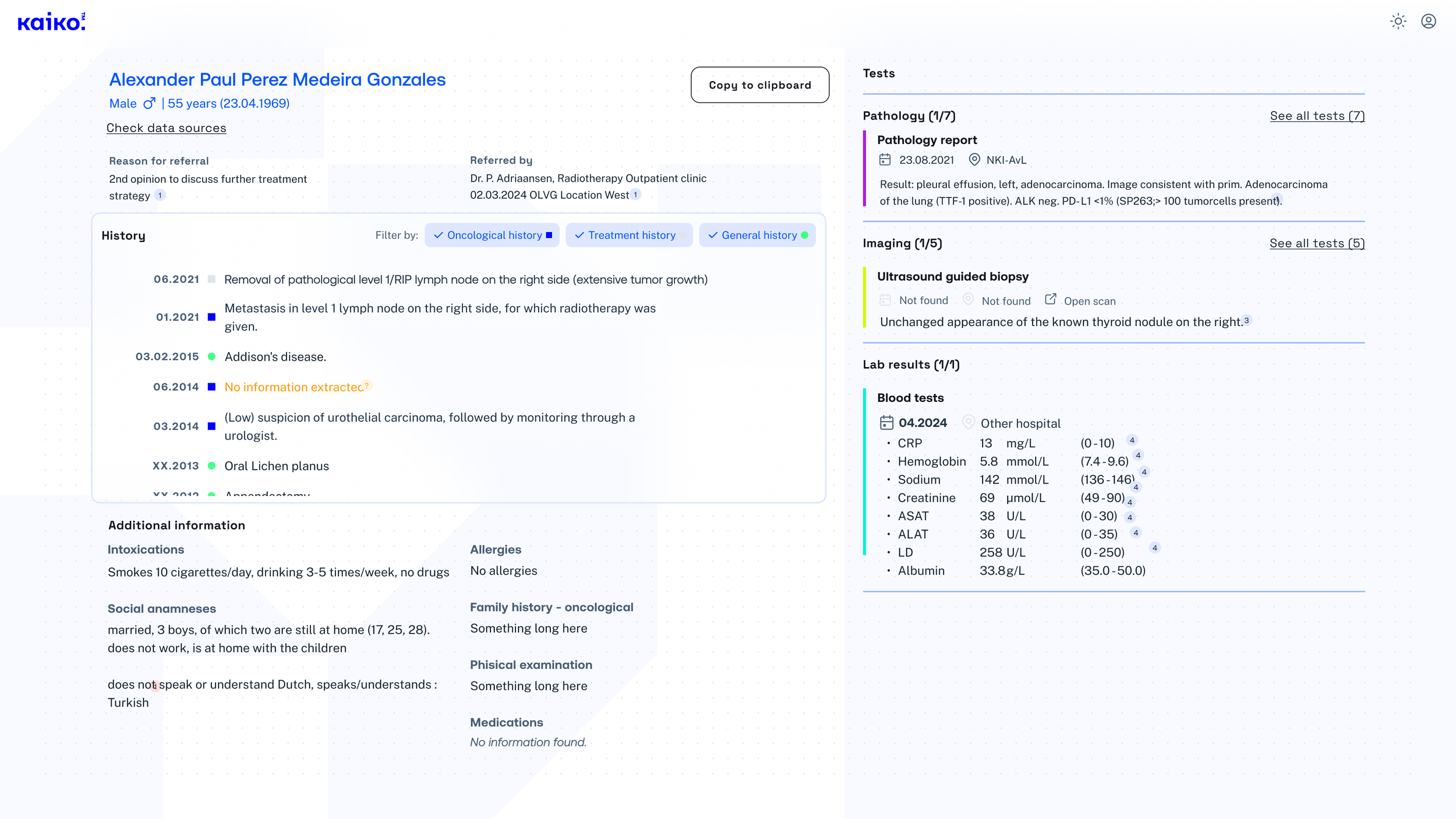
One page patient summary running at NKI Amsterdam (designed 2024). Data shown is not real patient data.
From isolated, prompt-driven tools (2023 to 2025)
A one page patient summary for first consultations, plus separate tools for single tasks (tumor tracking, WSI viewer)
This was a rendered view in the EHR (Electronic Health Record) with no clear way to reason on top
Answered one-off questions instead of structured work
To a clinical agentic workspace (2026)
A reasoning and preparation layer on top of the hospital record system
A patient-aware agent that understands intent, gathers context, uses tools and drafts editable documents
The agent prepares, the HCP reviews and decides
Step 1: Research & Discovery
Understanding how HCPs really work
Before shaping the MVP, we needed to understand how HCPs actually used the first version of kaiko.
In June 2025, I was part of the research team that ran our first user feedback interviews: 30 minute remote sessions with test users from our partner hospitals, from health care professionals (hcps) and pathologists to researchers.
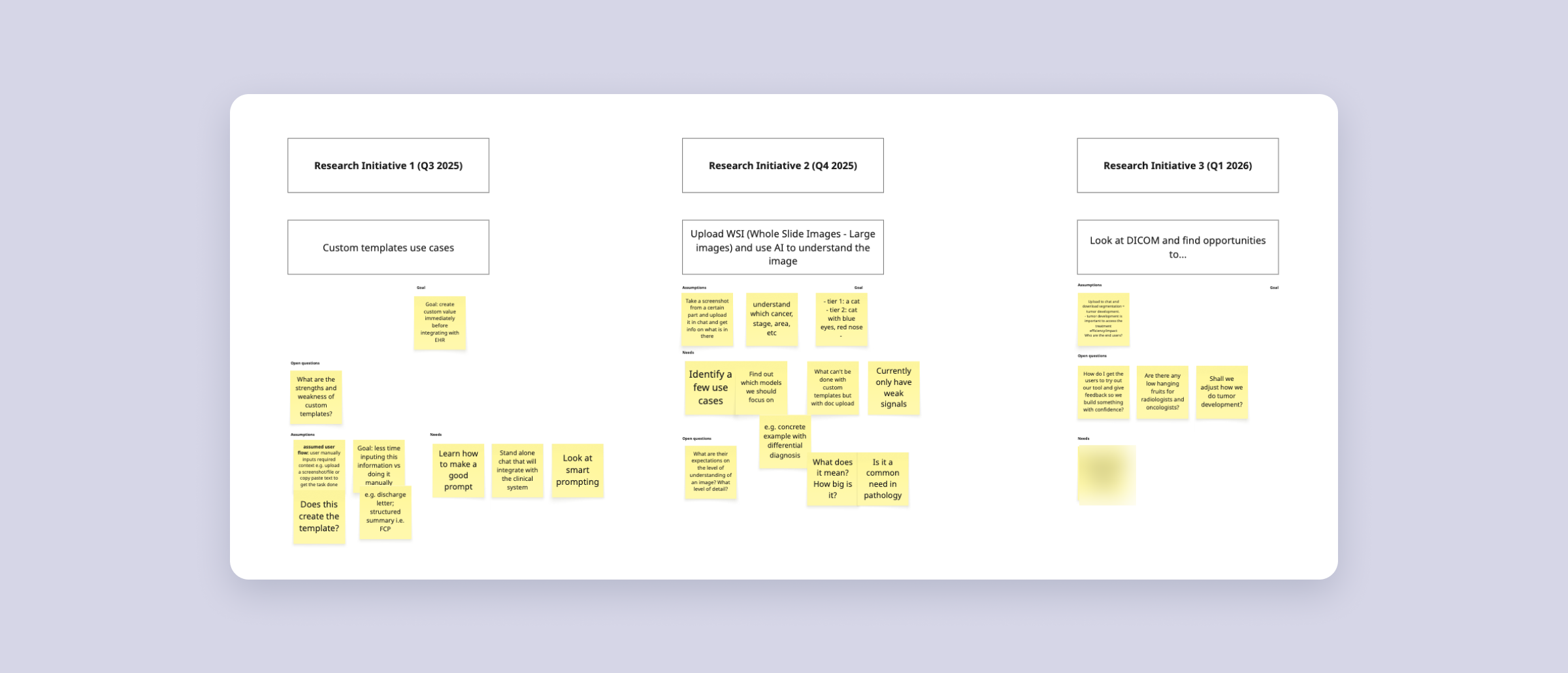
Planning user research for MVP.
What we heard
💬 Having the patient's context in the conversation adds value
💬 "If you check information, you want to see the source"
💬 Much of their information lives in files, images and slides
💬 Repetitive tasks like consult prep and letters need templates
💬 Disclaimers felt too technical and legal
What it became in the MVP
→ Patient-aware sessions
→ Citations that open the exact passage
→ File uploads, later group knowledge
→ Workflows, starting with consult prep
→ Use human-centered language
Mapping the user journeys
In early 2026, I then explored the three foundations of the MVP in parallel: sessions, knowledge and the patient base. Through user journeys, I mapped who owns which information, an HCP, a group or the hospital, because that decides what the agent is allowed to see.
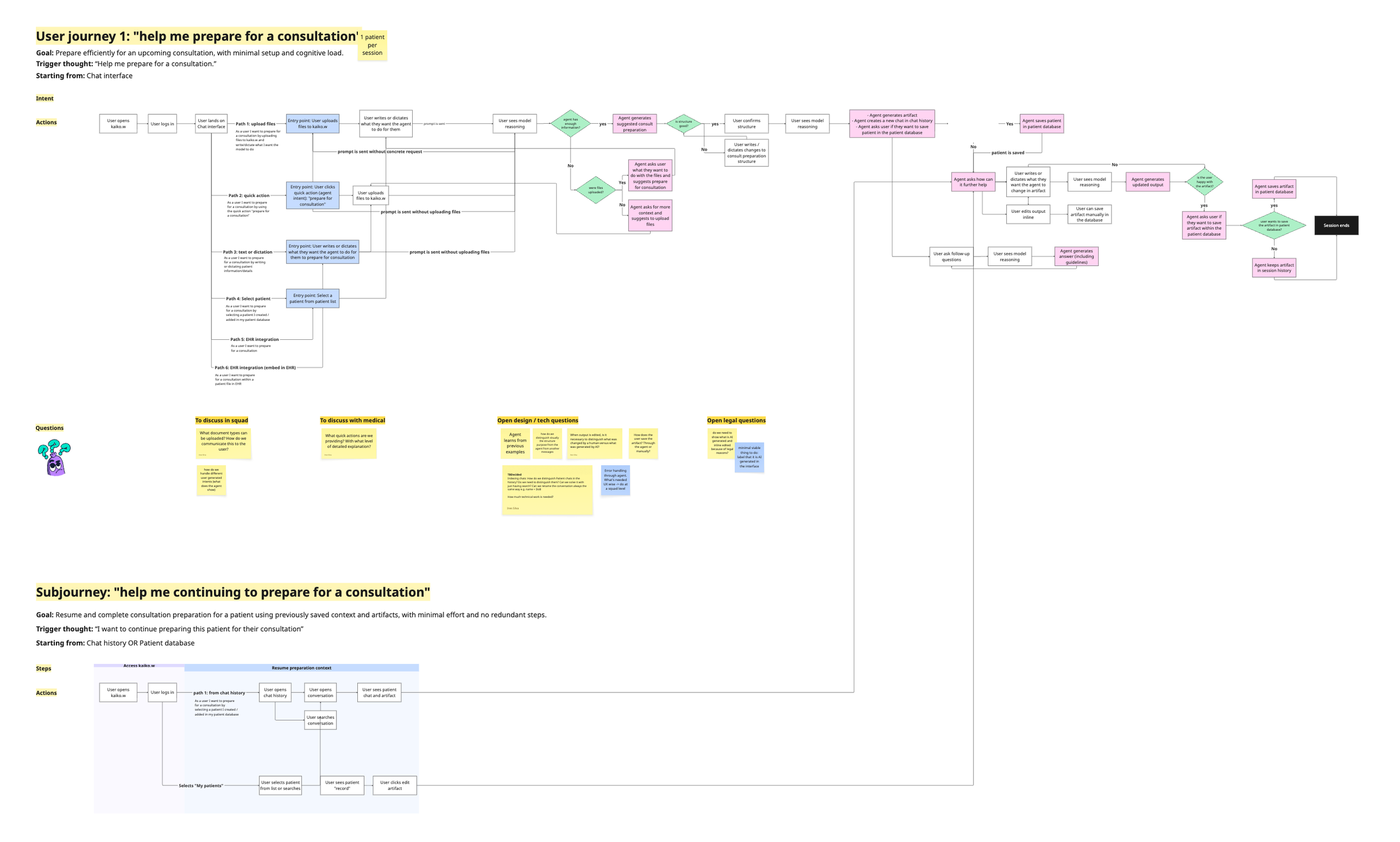
Part of working session: Scope, ownership & UX approach for agentic kaiko workspace (phase 1)
Step 2: Define & Prioritize
Shaping an MVP built to grow
Three principles guided every decision: one core agent with many intents, the agent prepares while the HCP steers, and a simple UI on top of a complex system.
Conversations about the MVP started in February 2026, and we built it over the summer. We broke it into milestones, each a user journey the squad could ship and the validation team could test:
Agent session with uploads, my knowledge and patient context
My Patient Base
Documents: generate, edit and save to patient
Group knowledge
Consult prep workflow, the flagship use case hospitals asked for
My role: I designed the product and took on PM work for most milestones, alongside our PM. I wrote, prioritized and defined tickets and user stories from the PRD together with the squad lead, and aligned ML, engineering, clinical and marketing.
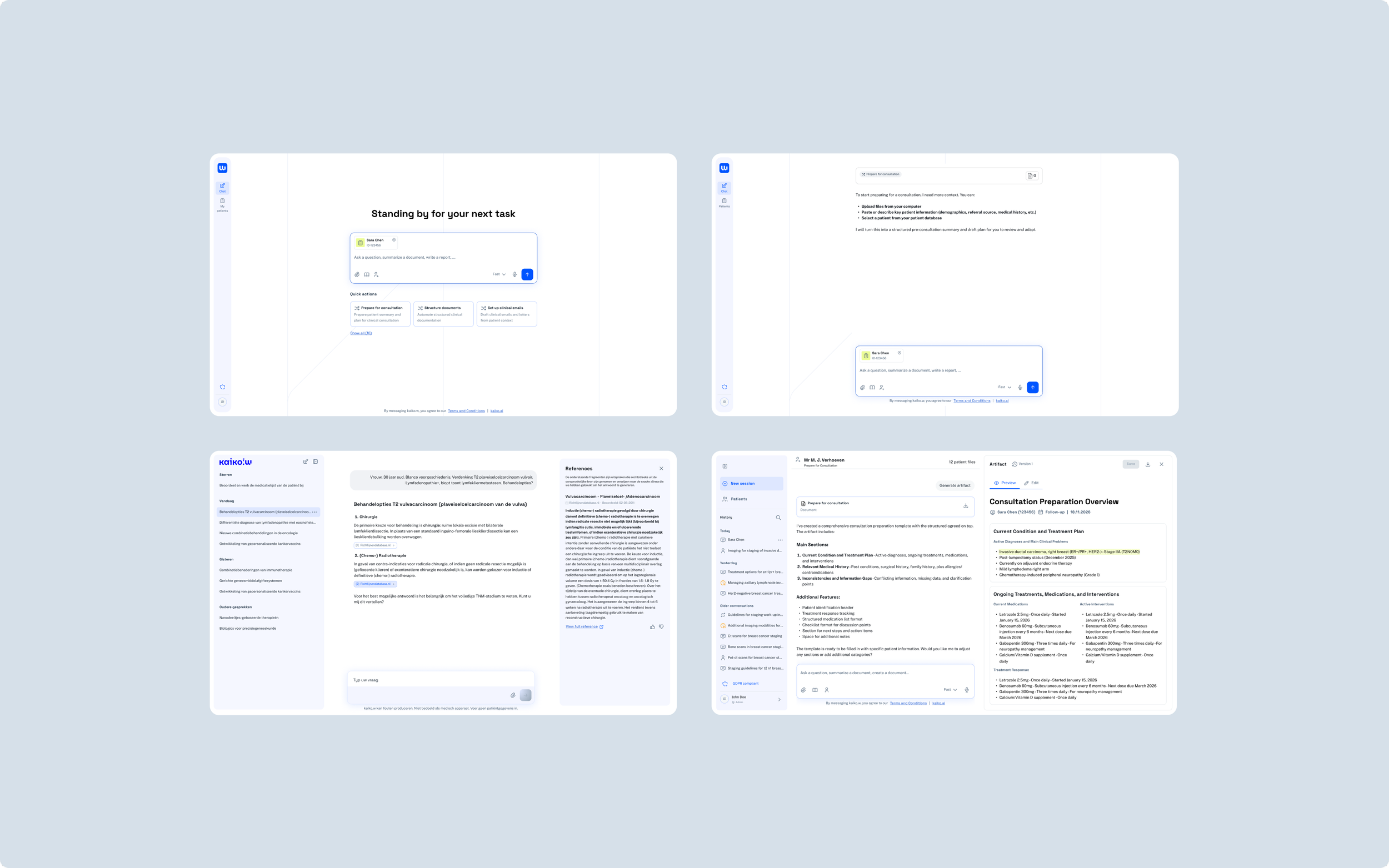
First explorations for the MVP. Data used is not real patient data.
Step 3: Design & Build
Designing for trust
In healthcare, an AI answer is only useful if an HCP can check it. So most of my design work went into making the agent’s work visible, controllable and correctable.
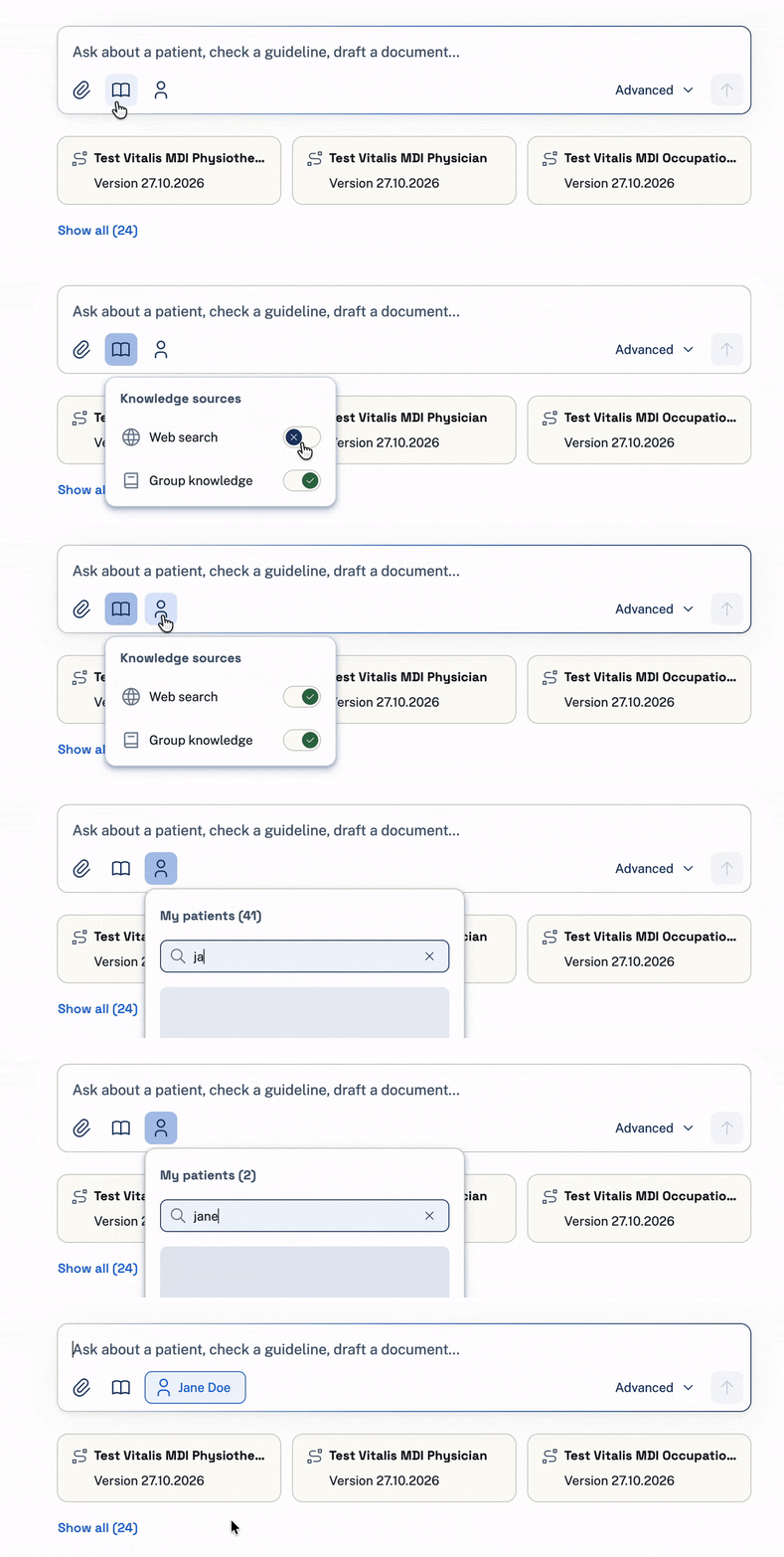
HCPs decide what the agent knows
Patient, files, knowledge and web search sit visibly in the composer. HCPs switch them on or off, and the agent only uses what's in scope.
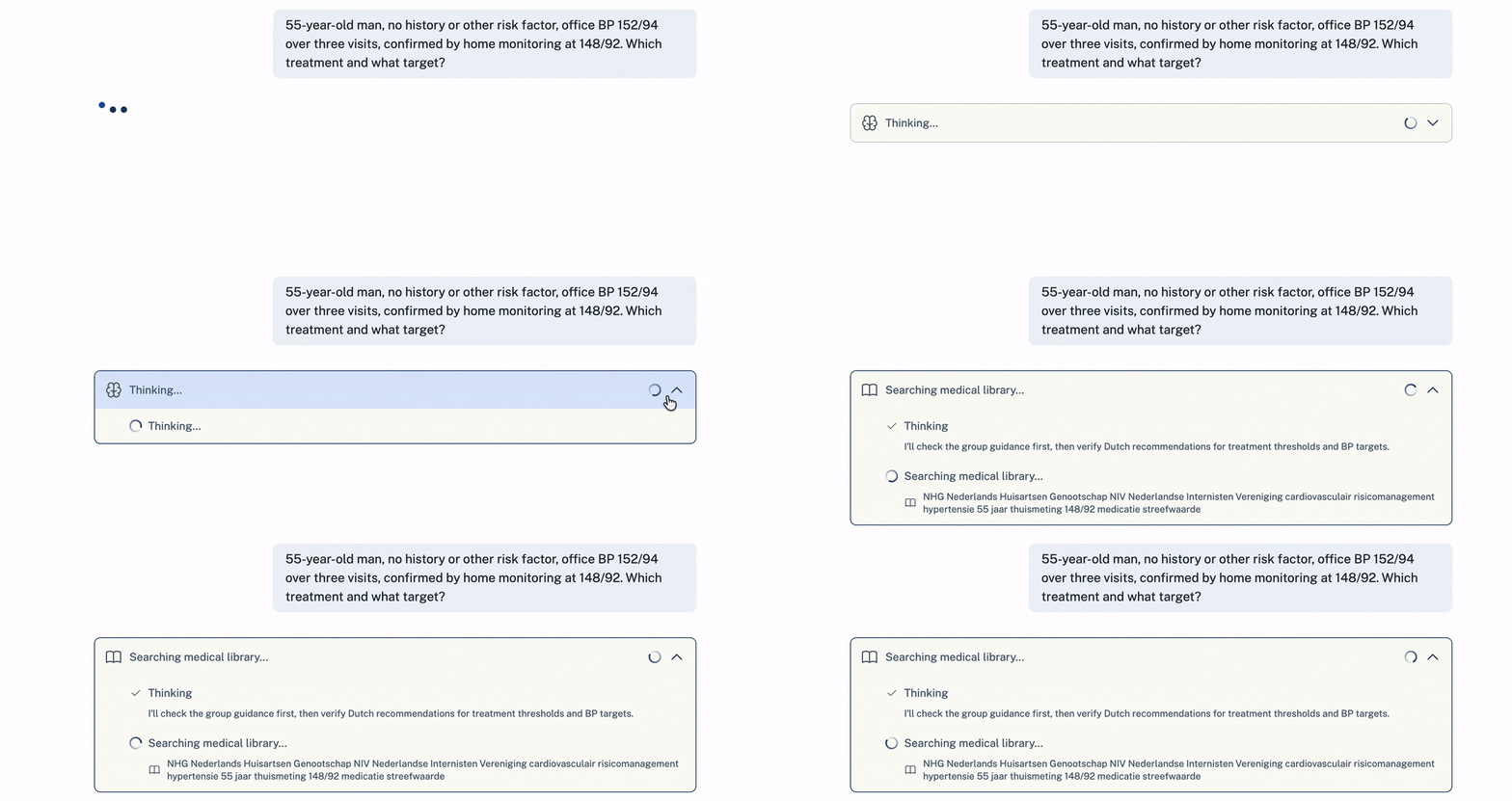
The agent shows its work, not its thinking
A readable work log, like "Searching selected documents", tells HCPs what's happening while they wait.
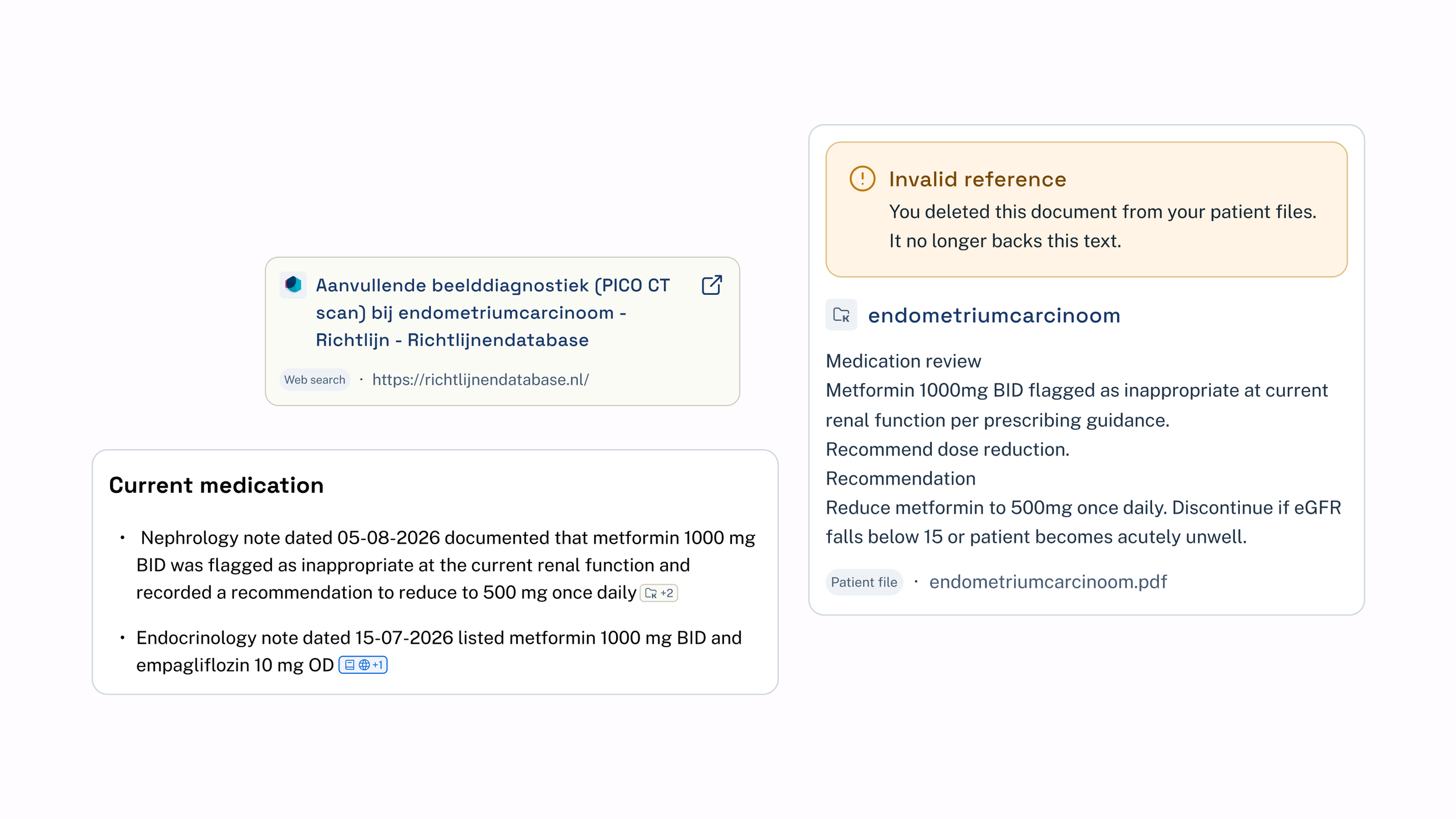
Every claim points to its source
Each citation opens the exact passage. Deleted sources stay visible as unavailable, and when documents contradict each other, the agent flags it so the HCP decides.
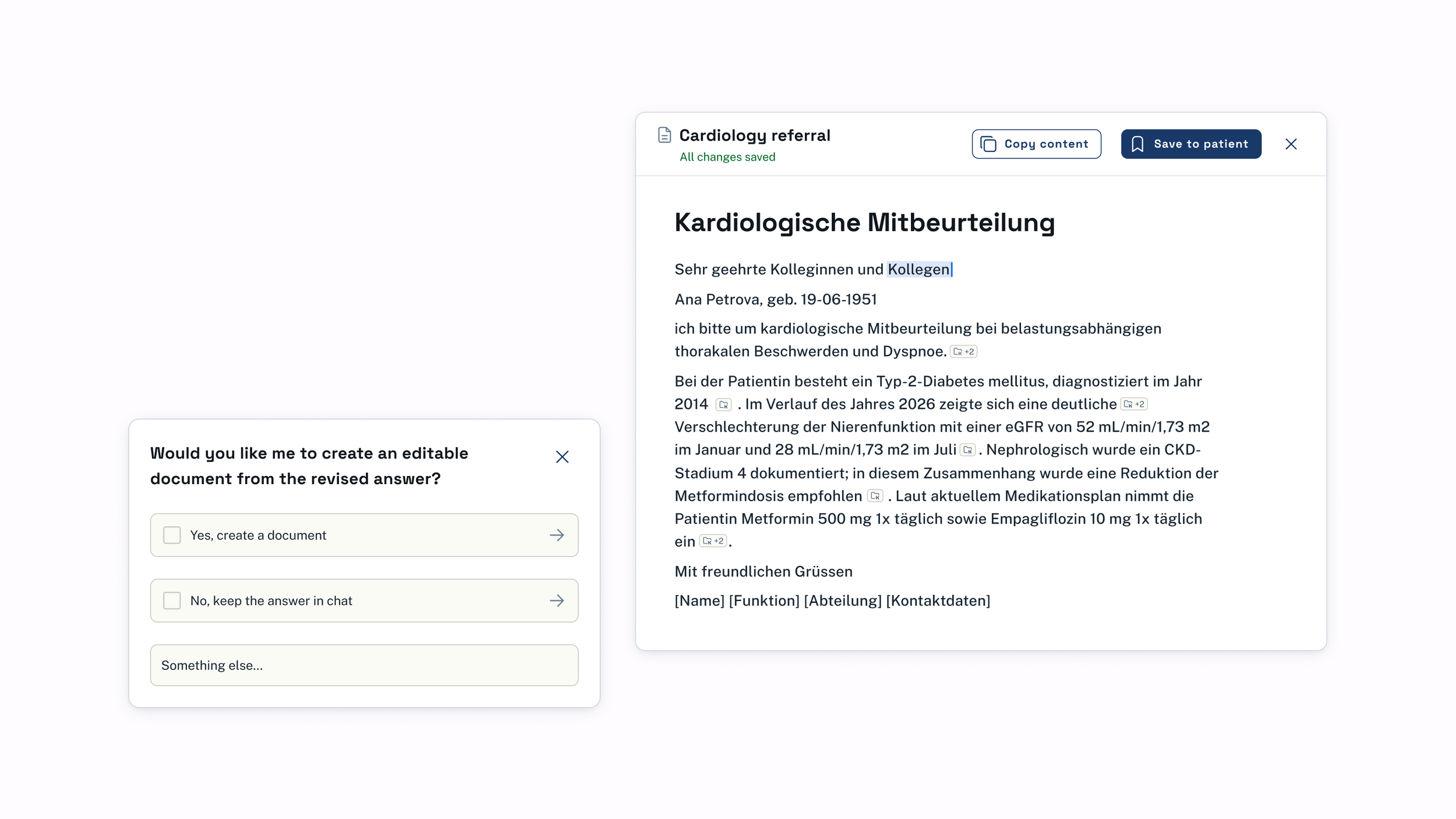
Documents stay in the HCP's hands
The agent drafts the document, and HCPs edit it or ask for changes before saving it to the patient. A warning shows when an edit might break a citation.
Step 4: Test & Iterate
Learning from real feedback
We tested the MVP with HCPs before launch, and keep learning from customers after it.
Before launch, a fellow designer led moderated usability tests with HCPs, and it was great to see the core of the design hold up.
Having the patient's context right there was what people liked most, and they understood the difference between patient workflows and general ones without us explaining anything.
The tests also showed us where trust can break and what we should take to the next iterations:
Agent steps that felt too vague
Sources that were hard to reach
A save button people expected to send the document straight to their hospital record
Solution
Kaiko workspace
kaiko workspace works on top of the hospital's patient files, so health care professionals can trust what they read and check it in one click.
What the MVP delivered:
Patient-aware sessions that keep all work linked to the right patient
Workflows we build with each hospital, starting with consult prep
Patient summaries covering medical history and tests, with inconsistencies flagged
Grounded answers from patient files, personal knowledge and hospital guidelines, every line linked to its source
Editable documents saved to the patient record
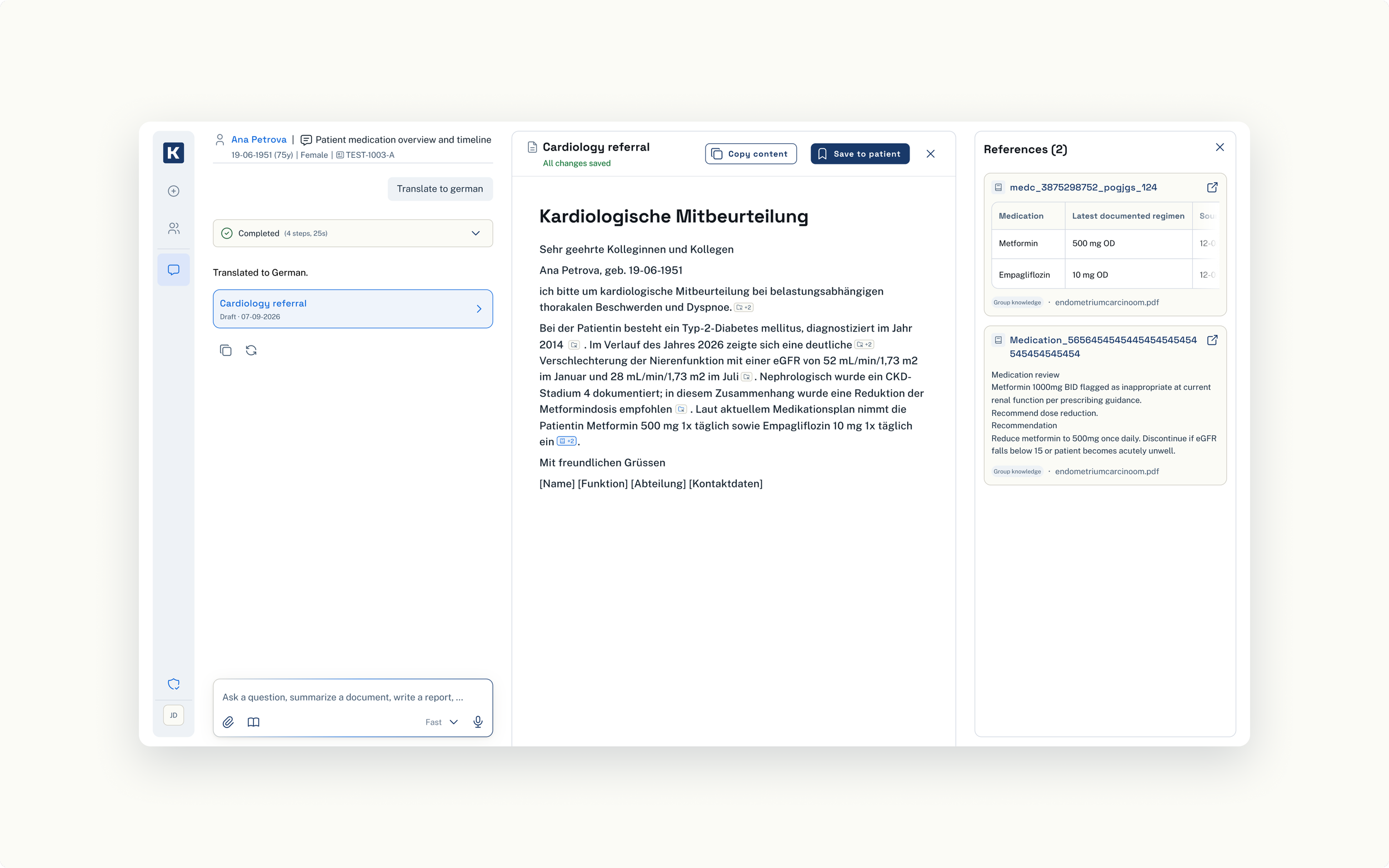
Document creation for referral letter with references.
Now in hospital pilots in the Netherlands and Switzerland, after usability tests showed no major risks in the core concept and HCPs immediately saw the value of an assistant that knows the patient's context.
Beyond the MVP
Growing the workspace
After launch, I kept evolving kaiko workspace, improving what we shipped and building what hospitals asked for next.
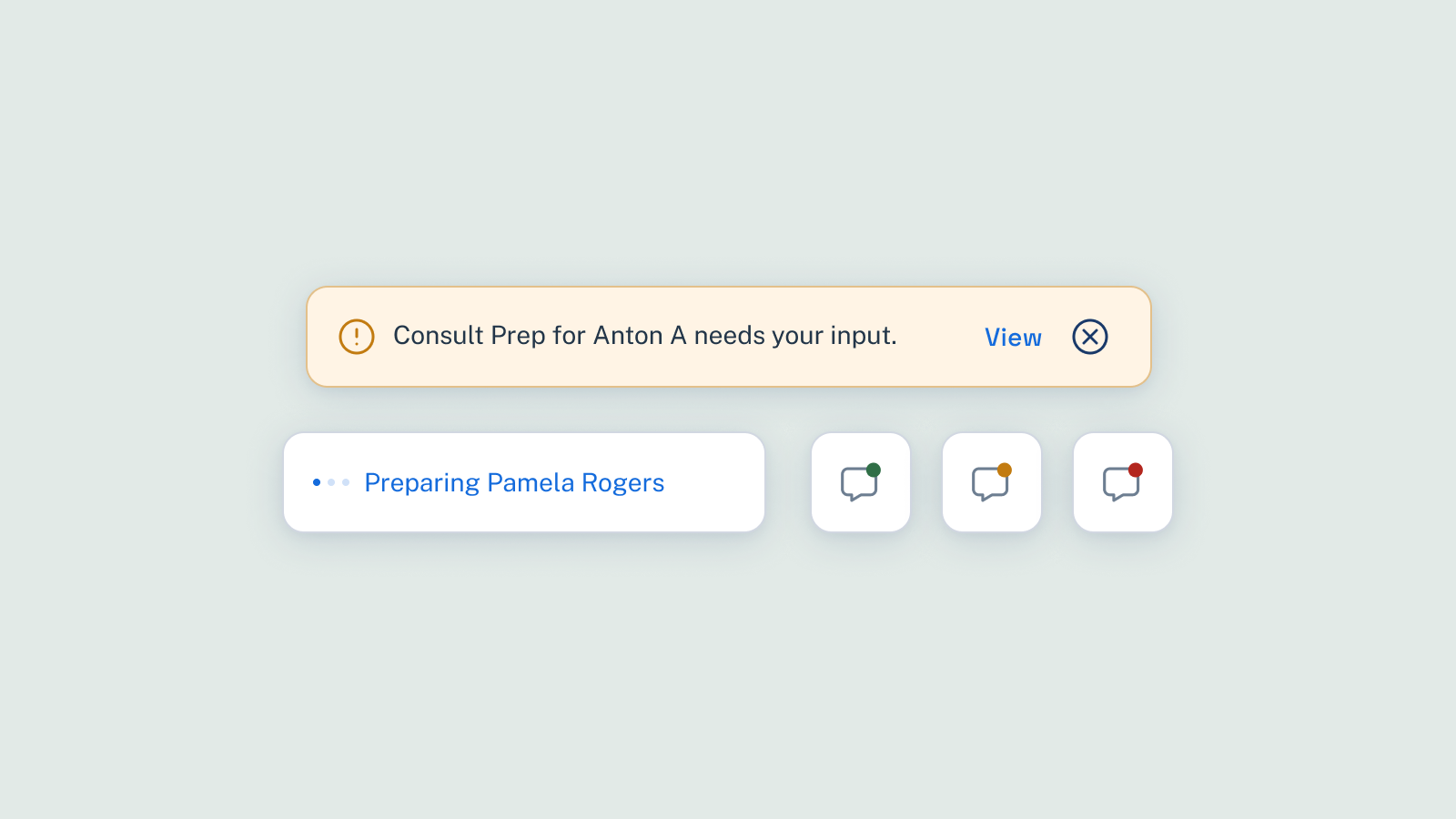
Background workflows: a hospital asked to run longer tasks, like consult prep for many patients, in the background. I led it from discovery to the final UI, and it shipped.
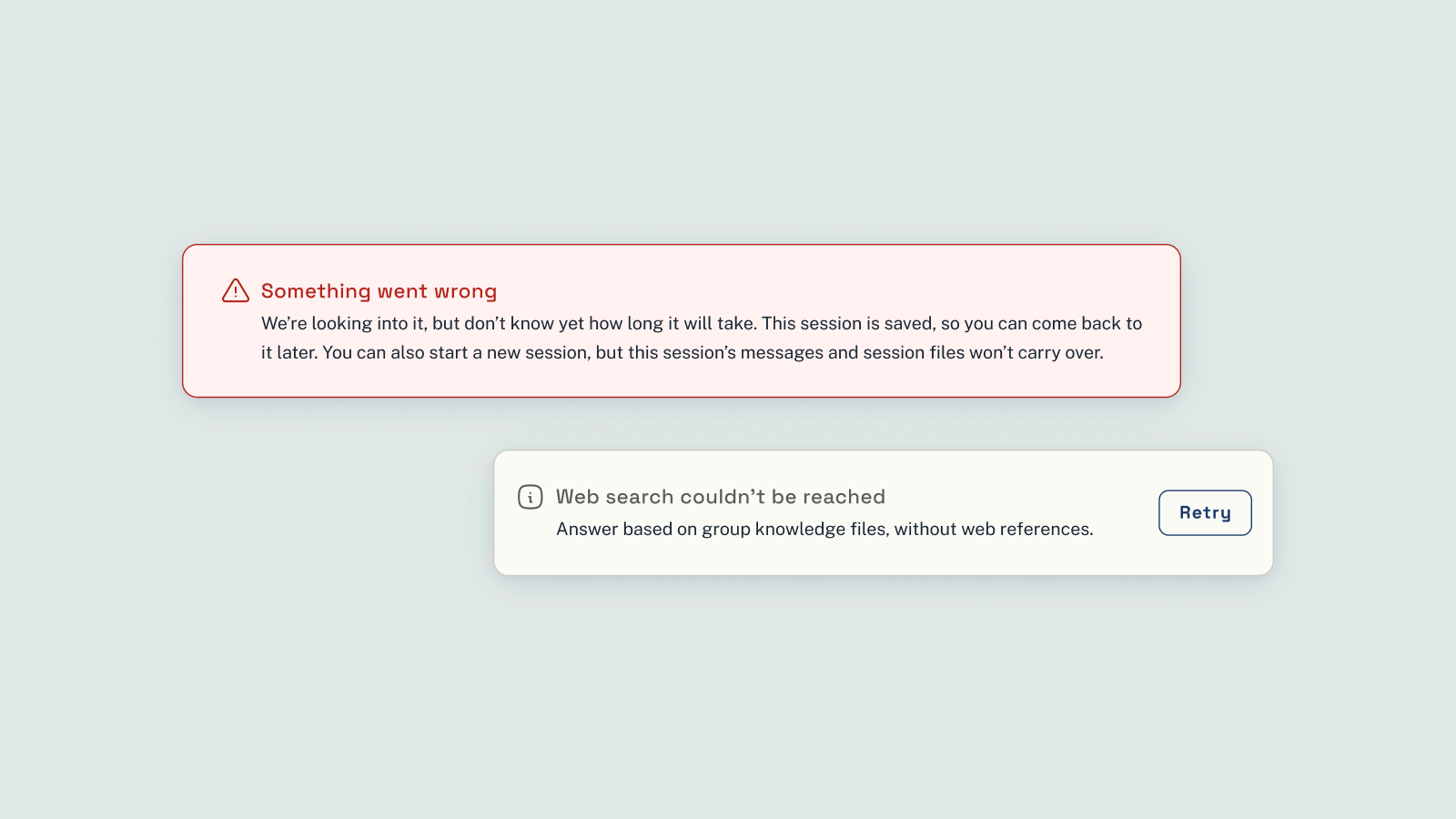
Error handling: clear messages when something goes wrong, focused on the cases that matter most.
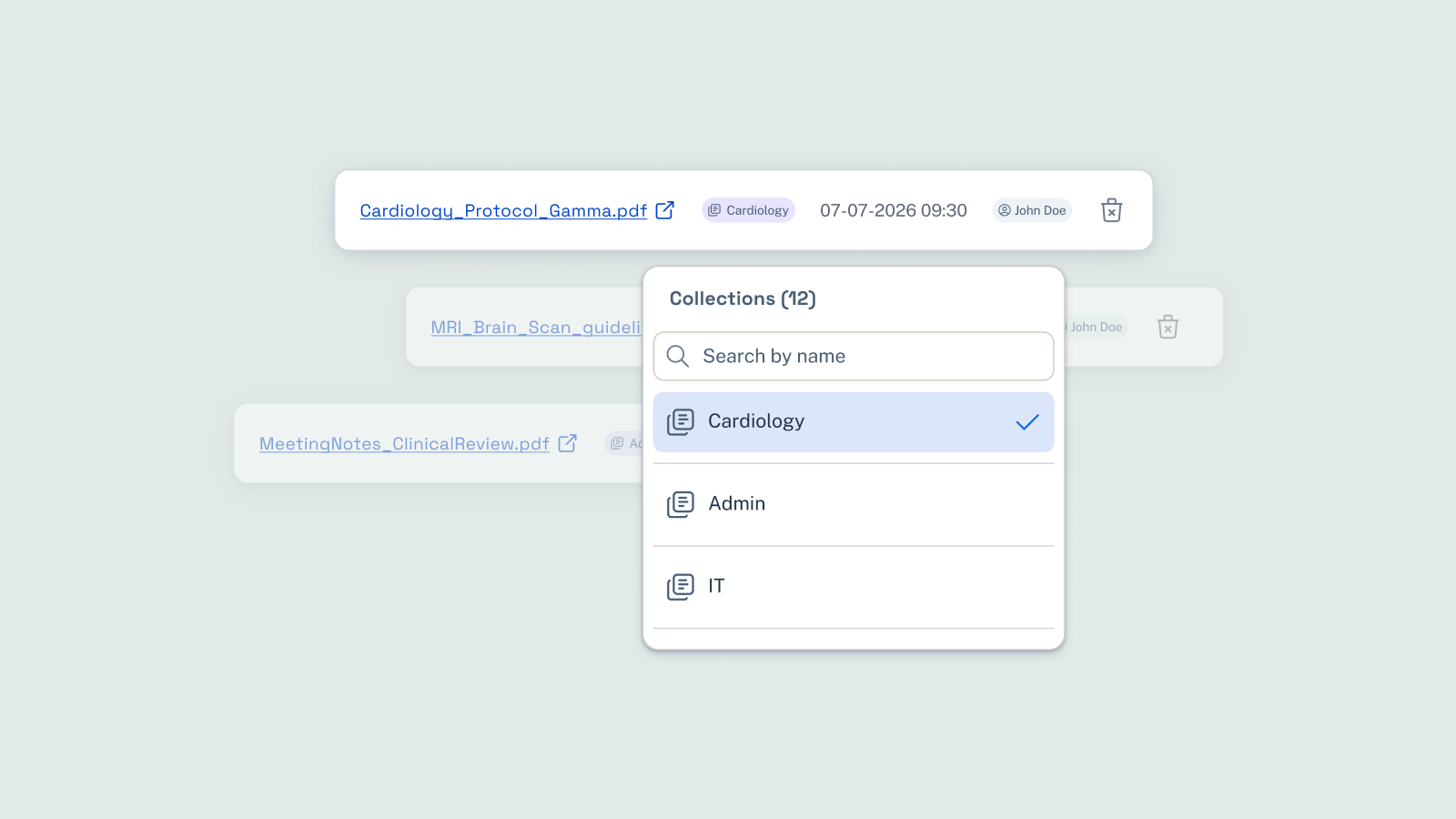
Group knowledge: shared knowledge for teams, with its own collection for each group.
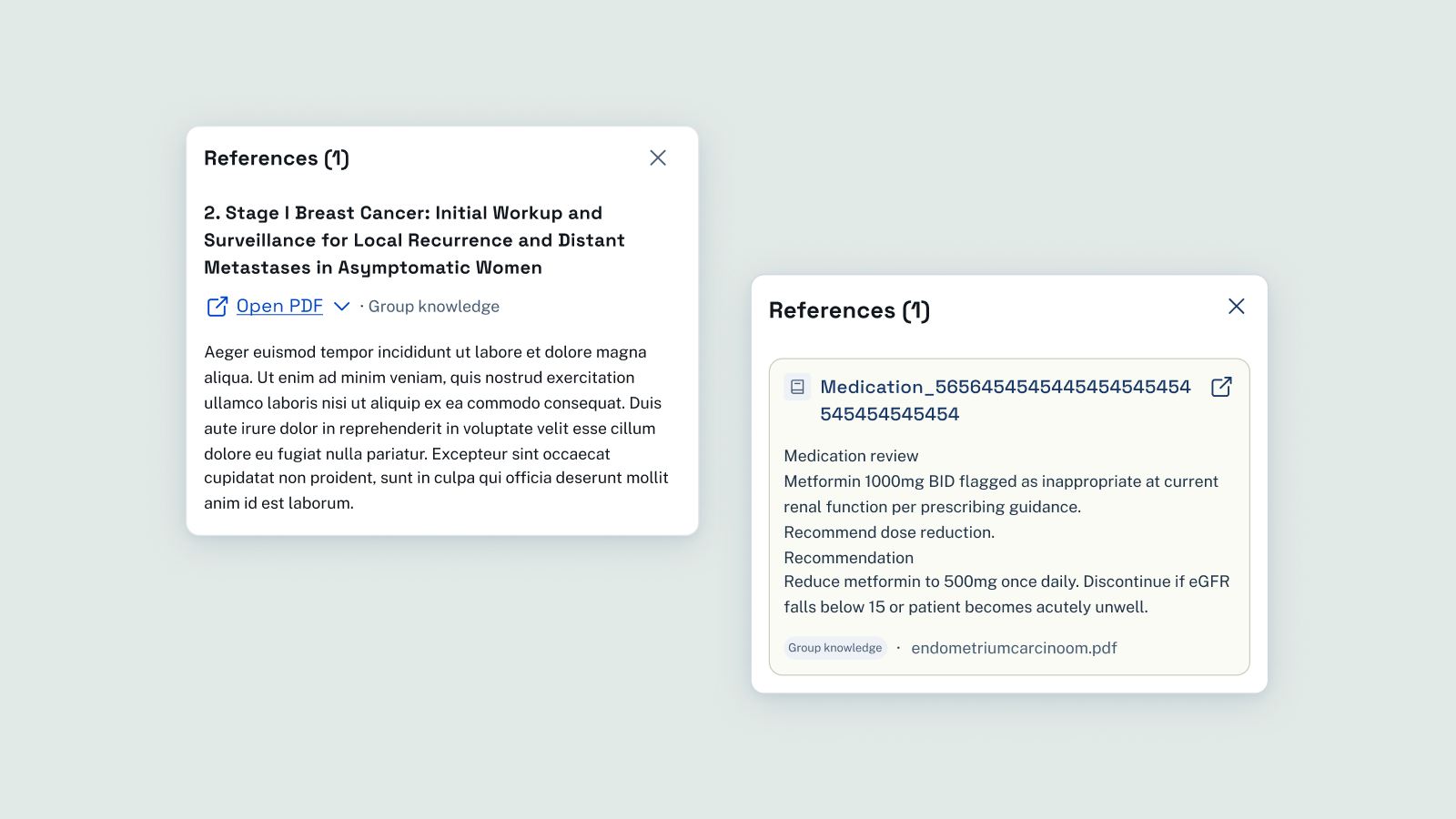
Continuous visual improvements: from the citations panel to the settings area, as the product grew.
Ways of working
Setting the foundations
Beyond the screens, I set up the tools the team uses to build consistently, and helped shape kaiko’s agentic design principles.
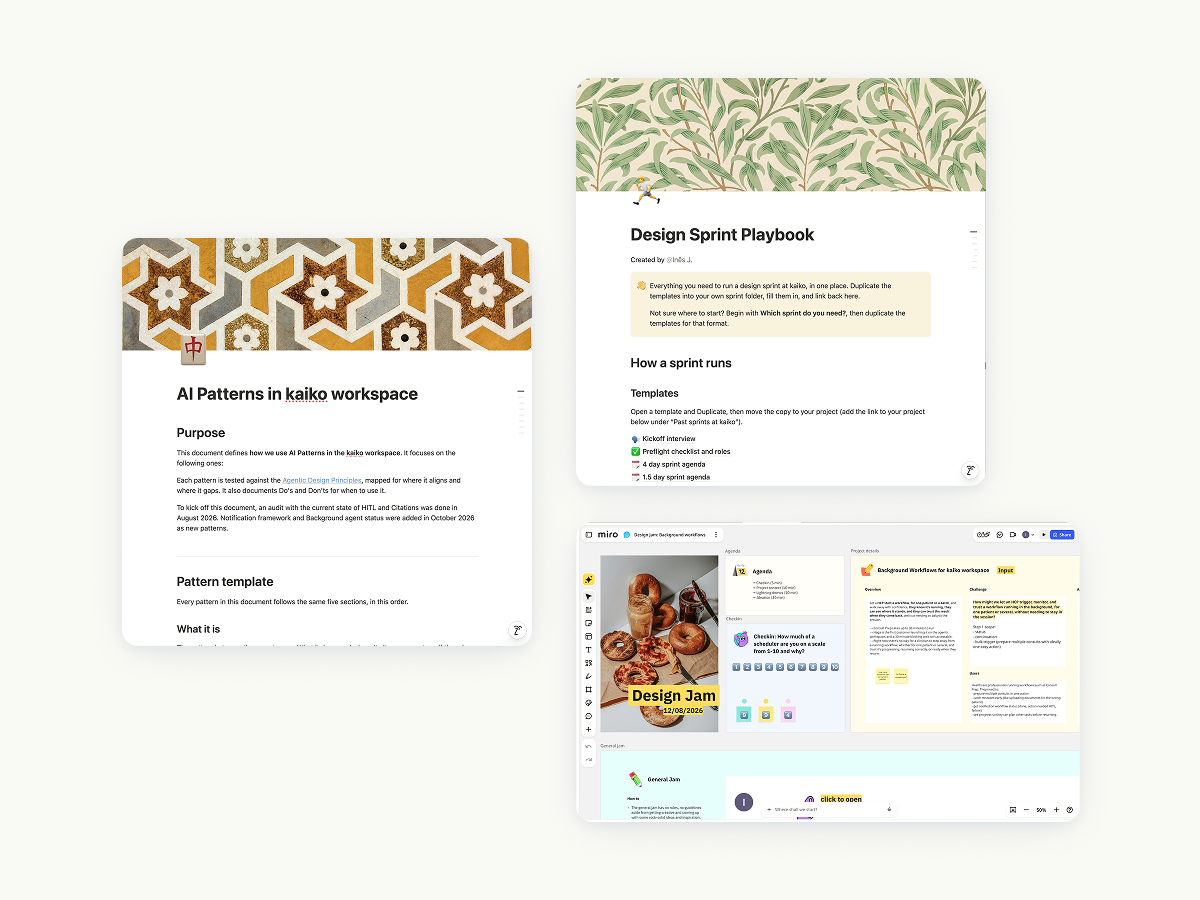
AI patterns in kaiko workspace: I audited and documented our agentic patterns, like human in the loop, citations and agent error flagging, so every squad designs them the same way.
Design Sprint Playbook: one place that brings our sprint practices and knowledge together. The product team goes there whenever they want to run a sprint, anyone at kaiko can learn from past sprints, and it's much easier to use than before.
Frameworks: various frameworks to frame a problem before designing, and to review and validate design before it ships.
What I learned
kaiko showed me how different it is to design for healthcare, compared to the lifestyle apps I worked on before. With agentic AI, there’s a whole new layer to design for: the model.
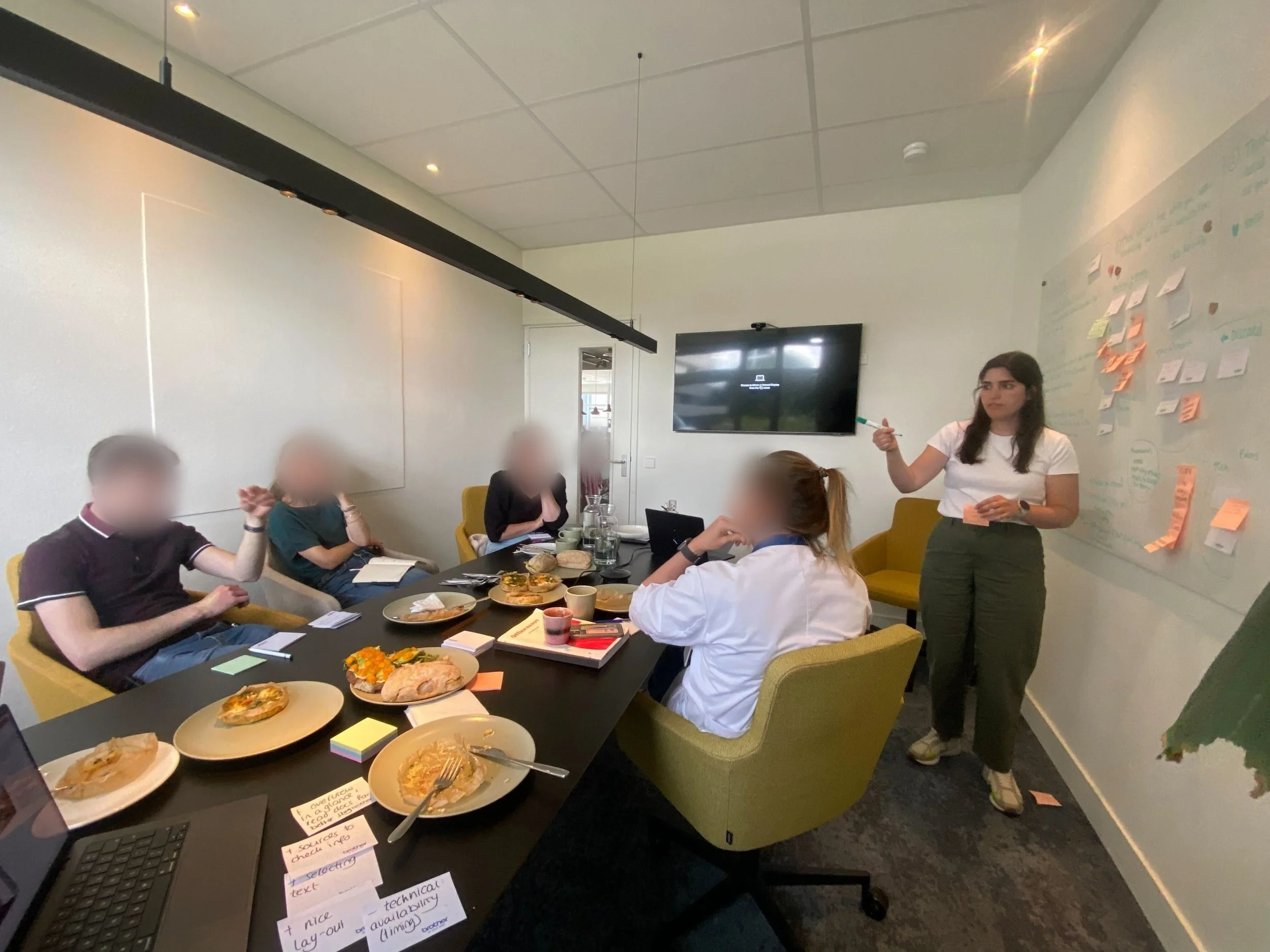
1/ Problem first
Most of my time goes into understanding the problem, not into the design itself. And that only works by building it together with the team.
2/ Simple is not easy
A simple idea in a strategy session can take weeks to build. An AI-first product has so much more to think through than a wrapper around a model.
3/ Users as companions
Including HCPs from the start is crucial, so the product meets their needs and never feels too technical. They care deeply, because we are improving the work they do every day.
4/ Help over delight
It’s less about what pops and more about what helps. Balance the amount of information, and plan for what can go wrong from the start.